
In November 2024, MEGA, in cooperation with the WFM-IGP Transnational Working Group on values, faith-based perspectives and global governance, presented to the UN Climate Change Conference (COP 29) Protecting Our Common Climate System: Earth Governance for a Sustainable Future, an appeal endorsed by over 400 faith-based organizations and leaders.
The appeal speaks to the 80–85% of humanity that belongs to a faith community or identifies with a religious tradition, while also embracing those who are inspired by similar ethical values. It recognizes that effective Earth governance requires not only sound institutions and scientific knowledge, but also moral purpose and societal legitimacy. It therefore seeks to connect shared values with the Earth governance proposals being advanced by MEGA.
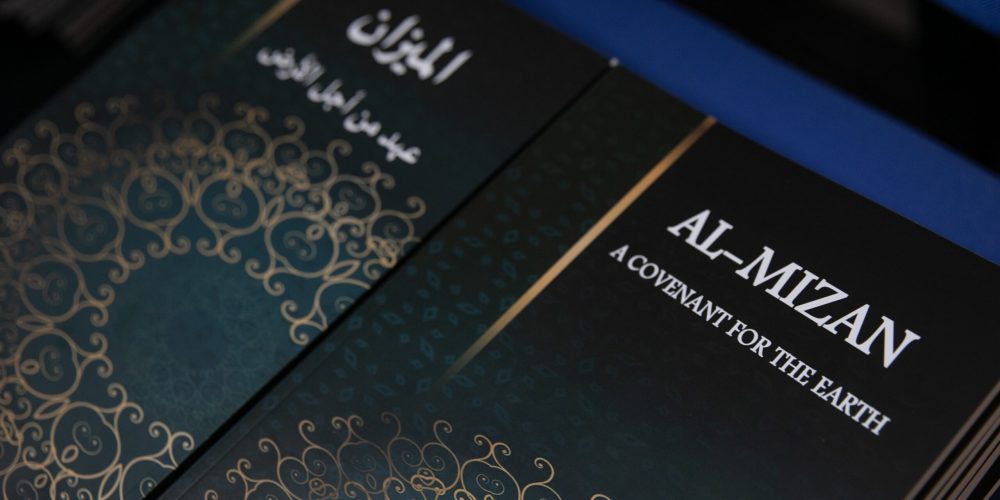
Building on this foundation, MEGA welcomes the Al-Mizan Foundation as a participating organization with whom we have begun cooperating to deepen engagement with Muslim communities worldwide, including through the Al-Mizan Covenant for the Earth.
The Al-Mizan Covenant for the Earth is a globally significant ethical framework rooted in Islamic teachings that articulates humanity’s responsibilities toward the Earth, all living beings, and future generations. It translates timeless Islamic principles into a contemporary vision for planetary stewardship, environmental justice, and sustainable development.
MEGA complements this ethical vision by advancing practical Earth governance reforms capable of translating shared values into effective international institutions, policies, and legal frameworks. Connecting faith-based statements like the Al-Mizan Covenant for the Earth to the related proposals of MEGA, demonstrates how conscience and governance can reinforce one another in responding to the Triple Planetary Crisis.
Protection of Creation
In Islam, protecting creation is considered a sacred religious obligation. Rooted in the Qur’an and the teachings of the Prophet Muhammad (“peace be upon him”), Muslims are designated as Khalifah (stewards) tasked with maintaining the Earth’s delicate balance (Mizan), while avoiding corruption and destruction (Fasad).
“He (God) set up the balance (al-mīzān) so that you may not exceed the balance. Weigh with justice and do not fall short in the balance. And the earth he has spread out for all living creatures.” (Qur’an 55:7-10), as cited in the Al-Mizan Covenant for the Earth.
Scientifically, creation can be understood as Earth’s living system: the interconnected web of life that sustains all species, including our own. Today, that system is under unprecedented pressure from the Triple Planetary Crisis of climate change, biodiversity loss, and pollution. These are not separate challenges, but interconnected symptoms of a single Earth system crisis. They therefore require a comprehensive global response.
MEGA is proposing a UN General Assembly Declaration of Unprecedented Earth System Risks and an International Earth System Crisis Response Mechanism to help humanity collectively address the triple planetary crisis.
A second proposal of MEGA related to this principle is to explore the design and establishment of a Global Environment Agency (GEA) or other such body. This could be created through an upgrade of the United Nations Environment Program (UNEP), in order to bestow UNEP with the capacity to more effectively manage our shared global environment. Alternatively, a GEA could be established as an entirely new institution.
Reciprocity and Equity
Reciprocity is the principle that you treat others the way that you would want them to treat you – a “Golden Rule” found across faith, ethical and religious traditions. In Islam it is found in the statement of Prophet Mohammad (“peace be upon him”), that: “None of you truly believes until he loves for his brother what he loves for himself.”
This principle naturally extends across generations. Environmental stewardship requires that we pass on to future generations a world that is no worse—and ideally better—than the one entrusted to us.
One effective way to ensure reciprocity and intergenerational equity is to establish a UN Special Envoy for Future Generations and Institutional Representatives of Future Generations local body, national and regional levels. Such institutional representatives ensure that planning and development today consider the rights of both current and future generations to a sustainable environment. There are some good examples of such representative positions already established, including the Wales Commissioner for Future Generations established by the 2015 Wales Wellbeing of Future Generations Act.
Justice, Fairness and Accountability
In Islam, justice (‘adl) and fairness (qist) are foundational principles of Islam and among the highest divine commands. The Quran mandates strict impartiality, requiring believers to uphold the truth and ensure fairness, even if it goes against themselves, their loved ones, or in the face of adversaries.
The principle of justice/fairness holds that use of Earth’s resources must be managed in ways which are fair and just for all people and to the environment itself. They cannot be squandered for the wealth of a few, and to the detriment of the whole. This principle provides the basis for fair management of resources, including resolution of environmental conflicts and application of law that respects human rights and the rights of nature.
In this context, MEGA calls, for example, for the Strengthening International Judicial Institutions for the Environment. This includes enhancing the jurisdiction of the International Court of Justice and the International Criminal Court to better deal with environmental issues, and establishing an International Anti-Corruption Court and an International Environment Court.
Stewardship and Earth Trusteeship
The Islamic principle of stewardship, known as Khalifah establishes humanity not as owner of the Earth but as trustee, entrusted by God to care responsibly for creation and to exercise compassion, restraint, and accountability in managing natural resources.
This principle resonates in the Earth Trusteeship Initiative featured by MEGA. Earth Trusteeship promotes philosophical, legal and political frameworks which may include, for example, natural entities that are managed under a legal ‘trusteeship’ to ensure their sustainability. This could include rivers, lakes, mountains, forests, national parks, national common areas or trans-national regions such as the global commons – which includes the oceans, atmosphere, outer space, seabed and Antarctica. Amongst other things, the Earth Trusteeship Initiative promotes the proposal of the UN Secretary-General that the UN Trusteeship Council to be re-purposed to provide better governance of the global commons.
Shared Vision for Planetary Stewardship
The environmental crisis is not simply a technical challenge. It is simultaneously a crisis of governance and a crisis of conscience. We have the science, the technology and the resources to protect the planetary ecosystem, but we struggle to translate this into action. We face a dual deficit: international institutions currently lack the capacity to ensure global protection, and societies often lack the moral connection to drive necessary change.
To move the needle, we must stop viewing policy and ethics as separate. That is why Mobilizing an Earth Governance Alliance(MEGA) and ethics and faith-based initiatives such as the Al-Mizan Covenant for the Earth are important collaborators.
MEGA sets forth proposals for governance, modernizing international law and building the robust, accountable frameworks needed to protect our global commons. Al-Mizan contributes an infrastructure of conscience, grounding environmental protection in universal values like Mizan (Balance), Khilafah (Stewardship), and Adl (Justice).
True change happens when we link policy to the institutions that touch lives every day. This includes global, national and local institutions. Faith-based organizations own or manage a significant percentage of the world’s institutions, especially those involved in education and medicine.
By aligning this vast network with the strategic goals of MEGA, we create a new form of “bottom-up” accountability. When faith-led universities and hospitals, for example, adopt these sustainability frameworks, they stop being mere service providers, they become custodians of planetary health.
This confluence bridges the gap between top-down reform and bottom-up transformation. It ensures that our climate goals are not just politically feasible, but morally compelling and culturally grounded.
Science tells us why our planet is changing. Faith and ethics provide the why for our response. Together, we aren’t just fixing systems, we are cultivating humanity to be capable of sustaining our home.
The future of Earth governance lies in the intersection of law and values. It’s time to govern with strength and act with conscience.


